· CBC News ·
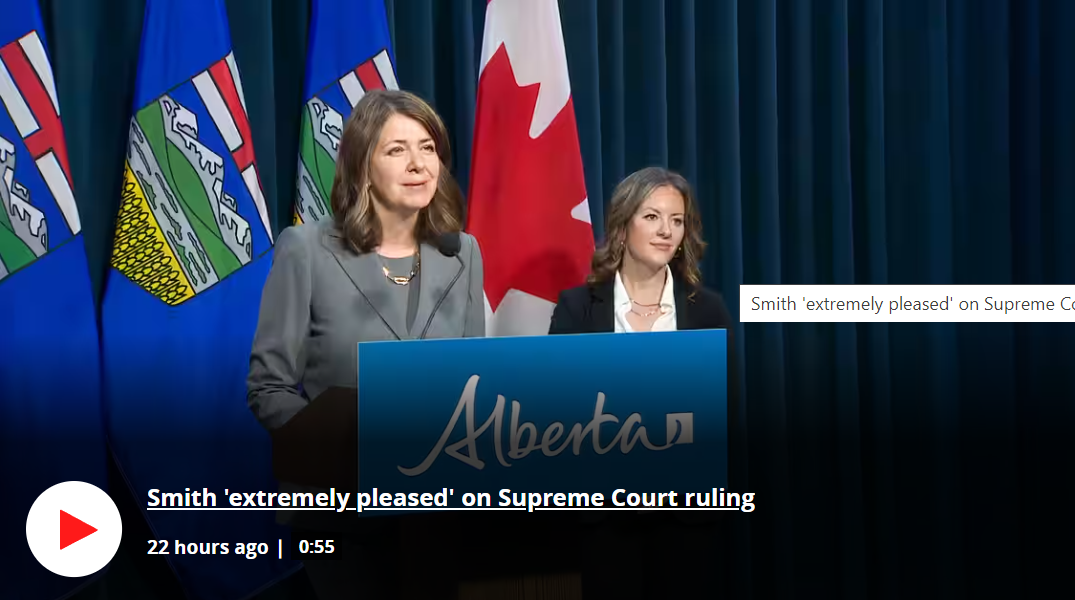
Prime Minister Justin Trudeau's government has unveiled many environmental policies over the years, such as the carbon tax and clean fuel standard, but experts suggest Friday's Supreme Court of Canada ruling on the Impact Assessment Act is a blow to Ottawa's climate ambition. (Nathan Denette/The Canadian Press)
Chalk up a win for the provinces and a loss for the federal government's environmental ambitions.
In a 5-2 decision released on Friday, the Supreme Court of Canada ruled against Ottawa and in favour of arguments from provincial governments about how major projects are approved in the country.
The ruling focused on the federal government's Impact Assessment Act (IAA), which gives federal regulators the power to assess potential environmental and social impacts of various major projects, such as pipelines, power plants and airports.
Experts say it's a setback, but not a critical blow to the federal government's environmental agenda, although it could have broader implications for other climate policies Ottawa is developing.
Meanwhile, it's a triumph for provincial autonomy.
In a nutshell, the top court took exception to the federal government overstepping its boundaries. There is also some caution about Ottawa regulating greenhouse gas emissions.
The decision clearly states the environment is an important issue, but the federal government can't overstep its boundaries into provincial jurisdiction, such as power plants and natural resource projects.
"Environmental protection remains one of today's most pressing challenges, and Parliament has the power to enact a scheme of environmental assessment to meet this challenge, but Parliament also has the duty to act within the enduring division of powers framework laid out in the Constitution," stated Chief Justice Richard Wagner, in the written decision.
As CBC reporter Erin Collins more colloquially put it on CBC Radio, a few minutes after the decision was released, "this was really Alberta telling the feds to stay off their lawn and the local bylaw officer kind of coming by and agreeing with them."
The ruling comes at an important moment when there is a need to attract investment into the country and to build the necessary infrastructure required for a growing, low-carbon economy. At the same time, there is an increasing focus on emissions as Canada tries to meet its Paris climate goals.
Many countries around the world are offering incentives to promote clean energy, for instance, but without an efficient permitting process, proposed projects can get bogged down.
The previous regulatory process under former Prime Minister Stephen Harper was described as too relaxed by critics, while the top court's ruling shows the system under Prime Minister Justin Trudeau went too far. Under both systems, it still takes multiple years for major projects to be approved.
The regulatory and permitting process has been in a state of flux for most of the last decade and Friday's top court ruling will no doubt cause further change.
Canada isn't the only country struggling with regulatory efficiency, according to Marla Orenstein, director of energy, environment and economy at the Canada West Foundation, a Calgary-based think-tank. She notes that the United States, the U.K., Germany and Australia all have similar issues.
"Everybody's saying that this regulatory process takes too long and is too uncertain and that it's going to impede our clean energy targets," Orenstein said.
"They have to figure out, how do you make it robust in terms of its environmental outcomes and keep that robustness, but at the same time make it transparent, make it consistent, make it predictable."
The Impact Assessment Act has long been controversial among conservative politicians in Alberta, including former premier Jason Kenney. In an interview with CBC, Kenney says the Supreme Court ruling is a reminder that provinces do have important powers.
The Alberta government led the fight against the IAA, originally called Bill C-69. It was characterized by many conservative politicians in Alberta, including former premier Jason Kenney, as the "no more pipelines" act.
Generally, the IAA was intended to improve environmental protection, while also trying to reduce the lengthy regulatory process and give an early indication to companies about a project's chances of approval.
The federal government has always had jurisdiction over reviewing projects on federal lands, or those that cross provincial or international boundaries, such as a large electricity transmission line.
As a result of the federal legislation, more projects required an assessment, such as certain highways and railroads. This expanded list of projects ultimately became the biggest problem, as highlighted by the Supreme Court.
Since 2019, the majority of the projects that underwent the federal assessment were from Ontario and Quebec, and the most common type of proposal involved mining.
"It's never been a huge number of projects that have gone through under this federal Impact Assessment Act. But at the same time, those projects tend to be fairly major and important ones, the big large ones that everybody is concerned about," said Orenstein.
"We've needed some certainty in terms of moving forward," she said. "There's a whole bunch of projects that have been waiting in the wings, not putting in an application, waiting to see what's going to happen."
One project that completed the process was the Cedar LNG proposal in British Columbia, which experts say was successful for a variety of reasons including the proponent's level of preparedness, its commitment to net-zero, and its level of Indigenous support.
Meanwhile, other projects were less fortunate, such as Suncor's base mine expansion project, near Fort McMurray in northern Alberta. The proposal to grow its existing oilsands operation is still ongoing, although its chances at success were regarded as minimal after federal Environment Minister Steven Guilbeault wrote to the company explaining that the project's emissions were unacceptable.
After Friday's ruling, the Suncor project may find a new lease on life. It will still require federal permits because of its potential impacts on migrating birds, waterways and fish, however, the minister's focus on emissions may need to be re-thought or reviewed.
Suncor did not immediately respond to a request for comment.
The elephant in the room is the question around just how far the federal government can go on greenhouse gases, according to Martin Olszynski, an associate professor of law at the University of Calgary.
He noted that the Supreme Court did uphold the federal government's carbon tax two years ago, but sent a message in this latest ruling that Ottawa doesn't have total control over regulating emissions.
"The Supreme Court didn't say you don't have that jurisdiction," said Olszynski, who acted as counsel for World Wildlife Fund Canada, which was granted intervener status in support of the IAA at the Supreme Court. "They just said you didn't make the case here for it. And if you want to come back, if you want to make it, you can make it. But you didn't do that here."
The ruling "clips a little bit the federal government's wings when it comes to climate change," he said.
The federal government has said it is reviewing the court's decision and plans to make changes to the IAA.
After introducing many environmental policies since taking office, the governing Liberals are set to roll out two more policies soon — the clean electricity regulations and the oilpatch emissions cap.
The top court ruling this week does not have a direct impact on those proposals, but experts say there's no guarantee that future federal policies wouldn't also be challenged in the courts.
"There's a bit of a warning here, a vibe from the Supreme Court that it wants the federal government to play conservatively," said Olszynski.
Some provincial governments are already objecting to those proposals, too, which could lead to another court showdown with Ottawa over who has the authority over what parts of the environment.
https://www.cbc.ca/news/canada/calgary/bakx-scoc-ruling-1.6995962
My comments on this story .
Every Canadian interested in the dysfunction of the Supreme Court of Canada needs to read the US case of Gideon v. Wainwright. SCC 38706 could have been a similar badly needed precident case for Canada that would have made dramatic improvements to our justice system.
Yesterday, CBC improperly invited comments on the trial of Cameron Otis and after I repeatedly posted that this violated Otis's right to a fair trial,
CBC removed all comments not to mention mine.
I posted numerous posts, and eventually many were approved and some even got up without awaiting moderation but within minutes or hours
with a few exceptions of short responses, all my posts were removed and eventually CBC stopped allowing comments on that story.
Money talks, when billions of dollars is at stake the SCC hears the case, but when it comes to fundamental justice, they put in the ear plugs, shut their eyes and trash any application that trial fairness in a criminal trial requires a lawyer
Posted
AWAITING REVIEW
This story should be "How the Supreme Court dealt a blow to injustice" but ends
up deciding that provincials rights trumped the federal governments. Its also
big money for the legal world and the legal world made mega millions of dollars.
The fundametal legal problem is to spot the issue and balance the
probative v the prejudice.
In the real world of criminal world the rights of the accused rarely ever
make to the Supreme Court of Canada even when cases jump the specific hurdles
set by the SSoC. Mega millions law firms get heard in the SSoC , individuals are
ignored.
Here is the problem, politicians authorize legal aid limited budgets and
instruct them to deny or cancel certificates in order to meet budgets.
That results in the most vulnerable going to trial without a lawyer , and
becoming another wrongfully convicted that society does not care about.
Every politician in Canada needs a wake up call, "Wrongful convictions"
cost society billions compared to the small cost of providing idigents, legal
representation in every criminal case.
this one did not make it
This one did not make it
Back in 1963 a drunk in florida was thrown in jail for years after a trial
without a lawyer, it went to the Supreme Court of the United States and became
mandatory reading case law for all law students in the USA.
Its called Gideon v. Wainwright and resulted in the US legal presumption
that a fair trial reques every accused to ben entitled to a lawyer.
In case 38706 the SCC covered for an Ottawa Judge who covered for the
ottawa police and created another wrongfull conviction by similarly denying
trial fairness by denying a lawyer.
This one made it
Apparently we are not allowed to mention the Supreme Court's refusal to acknowledge the issue of trial fairness requires representation by a lawyer.
This one did not made it
The Supreme Court of Canada unlike every other western country, fails to protect
the right of an accused person to a fair trial by having a lawyer.
38706 is a classic example of where the SCC refused to acknowledg this
legal presumption that was acknowledged in Australia the AHC case of R. v.
Dietrich and even back in 1963 the USSC case of Gideon v. Wainright established
the US public defender system that exists today, but not in Canada.
This one did not make it
Its offensive hearing the ficticious propaganda of the SCC where the basic
fundamental legal rights are ignored in order to deflect, divert attention to
feed
business to the rich law firms that seem to be on a production line using
the SCC and in 38706 to do a lower court judge a favor who in turn protected the
Ottawa Police by refusing to allow the accused a lawyer.
The right of an accused person to a fair trial by having a lawyer does
not exist in Canada , in Australia the AHC case of R. v. Dietrich and the USSC
case of Gideon v. Wainright established this vital legal presumption.
This one made it
The cesspool called the Supreme Court of Canada is a place where improper decisions protect those who shuld be held accountable. A judge of the SCC can and do hear applications for leave when a conflict exists and deny leave to protect their friends from embarassment. Check out 38706 where a SCC judge in a sole decision acted to protect the OCJ "the hockey decision judge" who repeatedly denied a the accused a lawyer to protect Ottawa Police from illegal acts.
this one made it
The Supreme Court of Canada is not the squeeky clean trustworthy place free of improper favours for friends. in 38706 a SCC judge in a sole decision acted to protect the OCJ "the hockey decision judge" after repeatedly denying an accused a lawyer and refusing to allow police video evidence that contradicted their own ficticious statements.
This one made it
The Supreme Court of Canada often does not want to hear the most important of legal issues simply because it will embarras one of their friends in the judiciary. Tha just takes one SCC judge to get to make a sole determination , that helps out a female judge. One such case is application 38706 where an OCJ decision protected the Ottawa Police from embarassment and railroaded the accused with a wrongful conviction where all row botham applications were denied.
SCC case 38706 is where the Supreme Court of Canada refused an application for leave on the issue that a fair trial requires representation by a lawyer.
Across Canada a few thousand dollars on a public defender can save the government $400,000 a year incarceration costs of the wrongfully convicted.
this one made it
At law school in the USA one key case they all get is Gideon v Wainwright, that brought about the US public defender system, and it means that every accused person gets a lawyer in a criminal matter. It means the court has to supply them transcripts etc. That right exists in every other country except Canada.
Today is no exception.
Awaiting review
Can anyone think of a more important legal issue than the right of an accused person to a lawyer in a criminal trial? The Supreme Court of Canada apaprently has no respect for the funamental principle that a fair trial requires a lawyer.
Awaiting review
Having filed an application for leave to appeal to the Supreme Court of Canada, its obvious that they make political decisions to engage in denial of applications for leave. Can anyone think of a more important legal issue than the right of an accused person to a lawyer in a criminal trial?
Ah, we cannot use the word corrupt in a post. This one got awaiting review
The Supreme Court of Canada supports our corrupt justice system by refusing to hear applications for leave involving the worst of the worst of the judiciary who write ficticious reasons for convicting the wrongfully convicted.
This one made it
CBC are again censoring posts. Here is my most recent 8 min ago that automatically gets the AWAITING REVIEW aka "censorship review"
Our Supreme Court makes a mockery of fundamental legal Rights. Canada is the one country where the highest court fails to state that a fair trial in a criminal matter requires representation by a lawyer.
This is a legal presumption that exists in every other democractic country except Canada.
Its Amazing, that CBC is inviting us for our feedback on this article while recently allowing us to feedback on the trial of Otis while, jury selection in progress. My posts on the the their decision to allow feedback on line were all removed, a few hours later the story suddenly had all feedback removed.
This one made it up
Trudeau has never ever mentioned anything about an accused person's right to
fair trial requires representation by a lawyer.
Across Canada thousands of accused persons go to trial, unrepressented
because Legal Aid is refused on bogus reasons to supposedly save the government
that cost without any consideration to the $400,000 a year cost of incarcerating
the wrongfully convicted.
This post made it up for a few minutes
There are far more important issues to be decided by the Supreme Court of Canada
rather than this political issue of climate change.
Canada is the one country where the highest court fails to state that a
fair trial in a criminal matter requires representation by a lawyer. This is a
legal presumption that exists in every other democractic country except Canada.
d
AWAITING REVIEW In Ontario law, its who you know that can determine innocence or guilt in a criminal matter. Know the police and they charge who ever you ask, if you are a victim of crime, and unpopular, you will suffer retaliation and end up wrongfully convicted.
If you speak out about injustice, odds are you will be wrongfully arrested, and suffer retaliation in the form of charges for having complained of their conduct.
This is a group who have qualified immunity, thats near total immunity, it means you will never get a fair trial, you legal aid certificate will be improperly cancelled ,
your trial will improperly fail to get disclosure and you will improperly be denied the right even to be your own lawyer.
Thats when they throw you in jail into a concrete box and continue to threaten you.
None of this would happen if the Supreme Court of Canada took their head out of the sand and made a declaration that trial fairness requires representation by a lawyer.